|
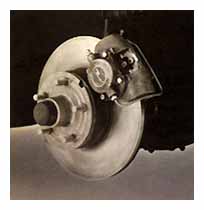
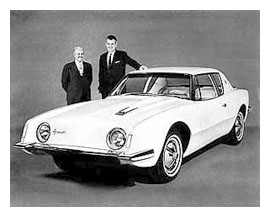
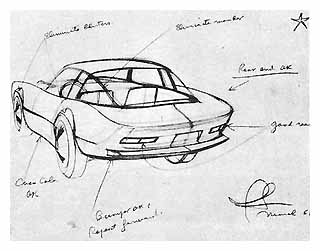
The Avanti, Part I Studebaker had once been one of the most dynamic car companies in America. The dramatic 1947 models designed by Raymond Loewy and Virgil Exner had stunned the industry in the summer of 1946 when they were introduced as the first all-new postwar cars from any manufacturer. The next complete Within two or three years, however, marketing blunders had driven Studebaker to death's door. The compact Lark, introduced for the 1959 model year, had given the company a reprieve, but Studebaker's directors had long since decided that the firm's future depended on diversification out of automobiles entirely. President Harold Churchill wasn't doing this with sufficient haste, so he was dumped and Sherwood Egbert — who came from outside the auto industry — was hired to replace him and execute the board's diversification plan. The only glitch was that Egbert liked cars. He was perfectly content to proceed with diversification as ordered, but he was equally determined to find some way to save the Studebaker car. Egbert had been giving serious thought to a radical new product since late in 1960 during his initial discussions with the board about the president's job. On one trip, during a lay-over at Chicago's O'Hare Airport, he bought some car magazines and, as he perused them, became convinced that Studebaker needed to produce something racy and European in order to bolster its sad image. As he recalled it later, somewhere between Omaha and Denver he grabbed some stationery and began sketching ideas. On March 9th, he contacted Raymond Loewy and asked him to take on another assignment for Studebaker. Loewy responded in the affirmative, and, within ten days, was hard at work on the project with three assistants at a rented house in Palm Springs, California. These assistants were his right-hand man, John Ebstein, plus Thomas Kellogg and Robert Andrews. Andrews had helped design the "Step-Down" Hudson of 1948, among other influential projects. Working around the clock, the four men produced a finished one-eighth scale clay model within two weeks. Loewy and Ebstein immediately departed for South Bend to present the model to Egbert. Three weeks after his initial meeting with Loewy, on April 2nd, Egbert was out in Palm Springs viewing the final one-eighth scale clay, and the final drawings. Egbert suggested a few minor changes, toasted the new car with a soft drink, and said, "Let's go!" Randall Faurot, chief of Studebaker's in-house styling division, assigned Robert Doehler to do the actual work entailed in developing Loewy's one-eighth scale model into a full-size prototype. Even before the one-eighth clay arrived back in South Bend, Studebaker's styling and engineering sections had built a buck for a full-size clay and prepared a separate seating buck using the basic interior dimensions. Up to this point the car did not have a name. Some of those involved in the project referred to it as the "Q" car, others as the "Model X" car. Later, it became known as the "X-SHE" car — the suffix standing for Egbert's initials. Loewy himself used the Lark emblem in an early drawing. There was considerable sentiment in South Bend for using the name "Packard." Others suggested going back even further in Studebaker history and reviving the Pierce-Arrow name in honor of the other great luxury marque that had been affiliated with Studebaker. It is not known for sure who first came up with the name "Avanti." Robert Andrews gives the credit to the D'Arcy Advertising Agency. Raymond Loewy gave the credit to Sherwood Egbert. Loewy himself designed the final Avanti script nameplate. The first major issue to be resolved regarding the Avanti was whether to build it of steel or of fiberglass. Egbert was favorable to fiberglass because of its successful use in the Corvette, which was the sort of car for which he was aiming. Gene Hardig, Studebaker's crusty chief engineer, examined the one-eighth scale model and agreed on the grounds that there was no practical way such a design could be built in steel. The cost for each individual body would be greater with fiberglass, but the crucial tooling costs would be much less. Fiberglass was also dictated by the initial production schedule of 1,000 units per month, substantially below the 1,700 to 2,000 units considered the minimum economical run for steel. As originally conceived by Egbert, the Avanti was to have been a two-seater, in the fashion of the previously mentioned Corvette. It was Hardig who made the decision to turn it into a four-seater. Egbert concurred and so the Avanti became the first of the new breed of sporty "personal" cars that was to revolutionize the industry following the introduction of the fabulously successful 1965 Ford Mustang. As the Avanti one-eighth scale clay model was blown up to full size, numerous changes were made. On one occasion, Egbert, attempting to negotiate the seating buck, gave his head a bump on the windshield pillar. Angered, he ordered the windshield to be made more vertical. Alterations were also made in the "coke-bottle" side contours, which were far more pronounced on the original design. The off-center hood bump was Loewy's creation. He had experimented with it on a Lancia he had built in Italy and it had been quite a sensation. The original design had called for the back-up lights to be in a continuous piece with the wrap-around tail light, but when the trunk lid design was lowered so as to bisect the two sets of lights, the back-ups were redesigned to create a two-inch gap. The thinking was that alignment would be a constant headache on actual production cars and that the separation would make discrepancies far less noticeable. Quad headlights were also part of the original proposals, but were deleted due to their cost. By dint of skill, dedication, and a great deal of overtime — twelve to fourteen hour days were the norm — Doehler and his crew were able to complete the full-size clay, including chrome detailing but not paint, by April 27th. This was barely forty days since Loewy and his group had begun work on the project in Palm Springs! Such speed was almost unknown in the industry and it created an atmosphere of tremendous excitement among all those involved. It seemed as if Egbert and his car were pulling Studebaker out of its fatal dive by sheer enthusiasm. On that same day, April 27th, Egbert showed the Avanti clay (see photo below) to the board of directors. Ebstein recalled that the clay model received a "standing ovation." So, as Egbert had hoped, the members of the board were won over sufficiently to give their blessing for actual production. Although they weren't automobile men, they were greatly impressed by both the quality of the design proposal and Egbert's utter confidence that the car was the answer to Studebaker's automotive problems. With the project officially on, work was undertaken to convert the clay mock-up into reality. Doehler set to work on interior design, Hardig set about the engineering tasks in earnest, and the production people began making molds from the mock-up to send off to Molded Fiberglass Products Company of Ashtabula, Ohio. Molded Fiberglass had been forming fiberglass panels for the Corvette for many years at that point, and was the only company with any broad experience in automotive fiberglass applications. Egbert and Loewy were especially concerned about the details of the interior design. Kellogg's initial sketches had sported aircraft-type overhead controls and full instrumentation. Egbert, who was big on aviation himself, approved and insisted upon an aircraft level of designed-in safety throughout the car. Thus, the instruments were lighted at night in red, not the white or green then standard in the industry. It was also at Egbert's behest that the unique Avanti roll bar was incorporated into the design. That, plus recessed controls and padded everything, made the Avanti interior not only attractive in appearance, but also among the safest ever installed in a production automobile up to that time. Eloquent testimony to this is that two decades later, after tremendous government regulation of the industry that forced each and every manufacturer to completely redesign its cars (and its ideas about its cars) several times over, the Avanti II was basically unchanged from the 1963 original. According to Loewy, Egbert had a phobia against sun visors, but Doehler was able to develop some unusual (and pretty worthless) visors that blended into the padding at the top of the windshield. They were non-directional, far too small to be of any real use, and were, in fact, one of the few serious annoyances in the whole interior. Another item that proved to be only marginally successful was the inside rearview mirror. At first it was placed on a stem on the dash, but on production models it was glued directly to the windshield, and as such was another industry "first." Unfortunately, it was too small and too poorly located to give very satisfactory rearward vision. Within about six months of the presentation of the full-size clay to the board, orders went out to suppliers for the interior parts, excepting those that Studebaker felt it could produce itself. Meanwhile, Hardig had been feverishly at work on the mechanical aspects. No money had been budgeted for a new chassis or drive train, so he began rummaging around the Studebaker parts bins to see what he could find to "make do." A veteran of years of effort at keeping Studebaker up to date on pitifully small budgets, he was not really surprised by Egbert's instructions regarding the new car: it must be tops in speed, braking, handling, safety features, and general innovation — and please don't spend any money. The fiberglass body with its relatively low rigidity required a strong frame. Hardig chose the reinforced X-member frame then being used on the Lark convertible, and added some strengthening where needed plus front and rear stabilizer bars and rear radius rods to improve handling. As originally conceived by Egbert, the Avanti was to have had independent rear suspension, but this was dropped due to the expense. Instead, the Avanti used front coil springs from the Lark heavy duty police package, and rear leaf springs from the Lark station wagon. Heavy duty, adjustable shock absorbers were also added by the time the Avanti went into production. When it came to powering the Avanti, Hardig was stuck with the same venerable V8 engine Studebakers had been using since 1951, and which for several years had been out-bored, out-powered and generally out-classed by nearly every other manufacturer in the industry. At its best, the engine, now bored to its practical maximum of 289 cubic inches, developed a paltry 225 horsepower with the aid of a four-barrel carburetor. Yet, Hardig had to do his best to turn it into a fire-breather (without spending any money, of course). For want of any reasonable alternatives, he resorted to some basic hot rod techniques: increased compression ratio, more valve lift, and so on. The real improvement, however, came from the optional belt-driven centrifugal supercharger. It was acquired from Paxton, which Egbert had just bought as part of his diversification drive. With the company came not only the much needed supercharger technology, but also the company president, Andy Granatelli. Granatelli subsequently proved to be a master when it came to promoting the Avanti's high performance qualities. The standard unsupercharged engine, known as the "R1," was capable of moving the Avanti at a pretty decent clip, thanks to the car's light-weight fiberglass construction. Studebaker at first refused to supply horsepower figures for the obvious reason that it was unable to compete with Detroit's 400 cubic inch monsters in that department, but it has since been established that the R1 engine produced approximately 240 horsepower. The supercharged R2 put out close to 300 horsepower. Egbert had specified that the Avanti should have superior braking capabilities. Hardig discussed this problem with the Bendix Corporation. He came to the decision that caliper disc brakes were what the Avanti should probably employ, but an actual order was not given to Bendix until February, 1962 — for May shipment! Bendix was in no position to completely engineer and tool an entirely new type of braking system in that short a period, so it arranged to manufacture under license from Dunlop the same disc brakes that had been stopping Jaguars for several years. Avanti was not the first American-built car to have disc brakes, but it was the Avanti that employed the first truly modern discs in America, and it was the Avanti that convinced Detroit to give them serious consideration. Borg-Warner engineered an all-new automatic transmission, which Studebaker called the "Power-Shift" transmission. It was a three-speed automatic with an unusual arrangement whereby the first gear was operated manually. The second and third gears operated automatically from the "drive" position. It was console mounted, as were the standard Borg-Warner three-speed and optional Borg-Warner four-speed manual shift transmissions. Against all odds, Hardig managed to take these diverse scraps and pieces and turn them into a genuinely competitive chassis. Toward the end, as the development program crept further and further over budget, several unplanned economies were necessitated. One of the most obvious is the wheel covers, which used left over dies from the 1953-55 models, and were painted to look like mags. The interior that was originally planned never saw production. The design called for unique Royalite moldings (similar to fiberglass) throughout the interior. After the design was well along, Egbert realized that the entire project was running $1 million over budget. At Studebaker in 1962, that was a lot of money, so the ambitious interior design was modified drastically. The original instrument panel remained, but the Royalite was replaced by carpeting and by individual vinyl sections that were padded, pleated and sewn together. At least in Ebstein's view, this cutback saved the interior from being "alarmingly over-designed." Ironically, the interior ended up looking much more expensive because it had to be cheaper. By early 1962, the first prototype was ready to be assembled. (The photo, right, shows Loewy and Egbert with one of the first cars.) A strike by the UAW that year caused some delays, and Hardig remembered, "We put the first one together ourselves and smuggled it out to the proving grounds." As the New York International Automobile Show drew nearer, the work in South Bend became more and more feverish while final details were added to two prototypes. One was sent to New York just in time for the April 21st deadline. It was kept under wraps until the 26th when it was unveiled. On the same day the second prototype was unveiled at both a shareholders meeting and at a press preview in South Bend. An airlift operation flew an Avanti prototype to twenty-four cities in sixteen days as a dramatic way of introducing Studebaker dealers to the new car. A sign over the car in south Bend carried the slogan, "A new star is born."
|
 redesign in 1953 — this time a result of a collaboration between Loewy and Bob Bourke — produced a coupe body style that is still regarded as one of the most beautiful American cars ever.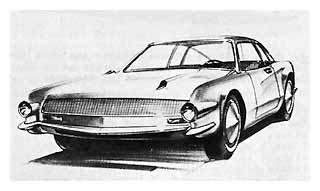
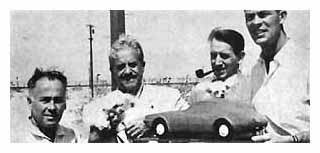 (Pictured here are, left to right, Ebstein, Loewy, Adrews and Kellogg with the original clay model.)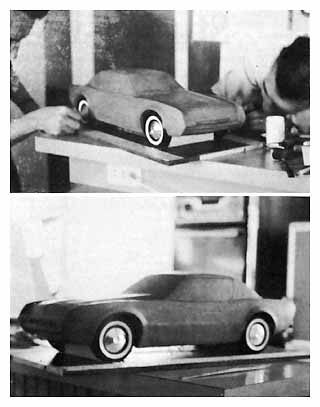
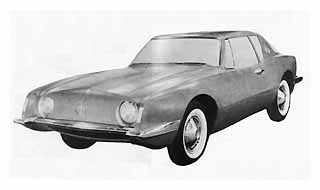
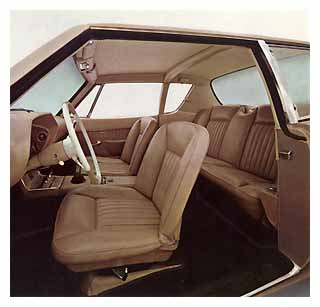 The interior shown below is probably from a late prototype.